
Brown County Property Tax Database
Brown County property tax records are held by the county auditor in Georgetown, Ohio. This southern Ohio county has an interactive GIS mapping system that lets you search for parcels by owner name, address, parcel number, or subdivision. The county is mostly rural with rolling hills and farmland. Property records include assessed values, ownership details, tax payment history, and parcel maps. The Brown County Auditor processes all assessments and maintains the property database for public access.
Brown County Overview
Brown County Assessment Process
The Brown County Auditor handles property assessments for the entire county. Under ORC Chapter 5713, the auditor must value all real property and conduct reappraisals on a six-year schedule. Triennial updates happen in between. Brown County's interactive GIS mapping tool is a key part of how the auditor tracks and manages parcels.
You can search the GIS system by parcel number, owner name, address, or subdivision. The map shows property boundaries, lot dimensions, and surrounding features. This is helpful when you want to verify where one parcel ends and another begins. Values assigned by the auditor are based on comparable sales, property condition, and land characteristics. The assessed value is 35% of the market value, which is the standard across Ohio.
During a reappraisal, the auditor's staff reviews every parcel. They may visit properties, take photos, or update building information. Triennial updates are less hands-on but still adjust values based on market changes. If you got a new value notice and it seems off, you have the right to challenge it through the Board of Revision process.
Searching Brown County Tax Records
Each Brown County property tax record contains the owner's name, mailing address, and parcel ID. The legal description, lot size, and land use class are also there. Values break down into land and building components. The total market value and assessed value appear on every record.
Tax information includes the current bill amount, past payments, and any delinquent taxes. Special assessments for roads, drainage, or other services show up separately. The Ohio Department of Taxation provides the statewide framework for property tax, but the Brown County Auditor manages the local data. You can look up records at the auditor's office in Georgetown or through any online tools the county provides.
The Brown County Auditor uses state guidelines to manage property tax records. The screenshot below shows Ohio's property tax statute page that governs all county assessments.
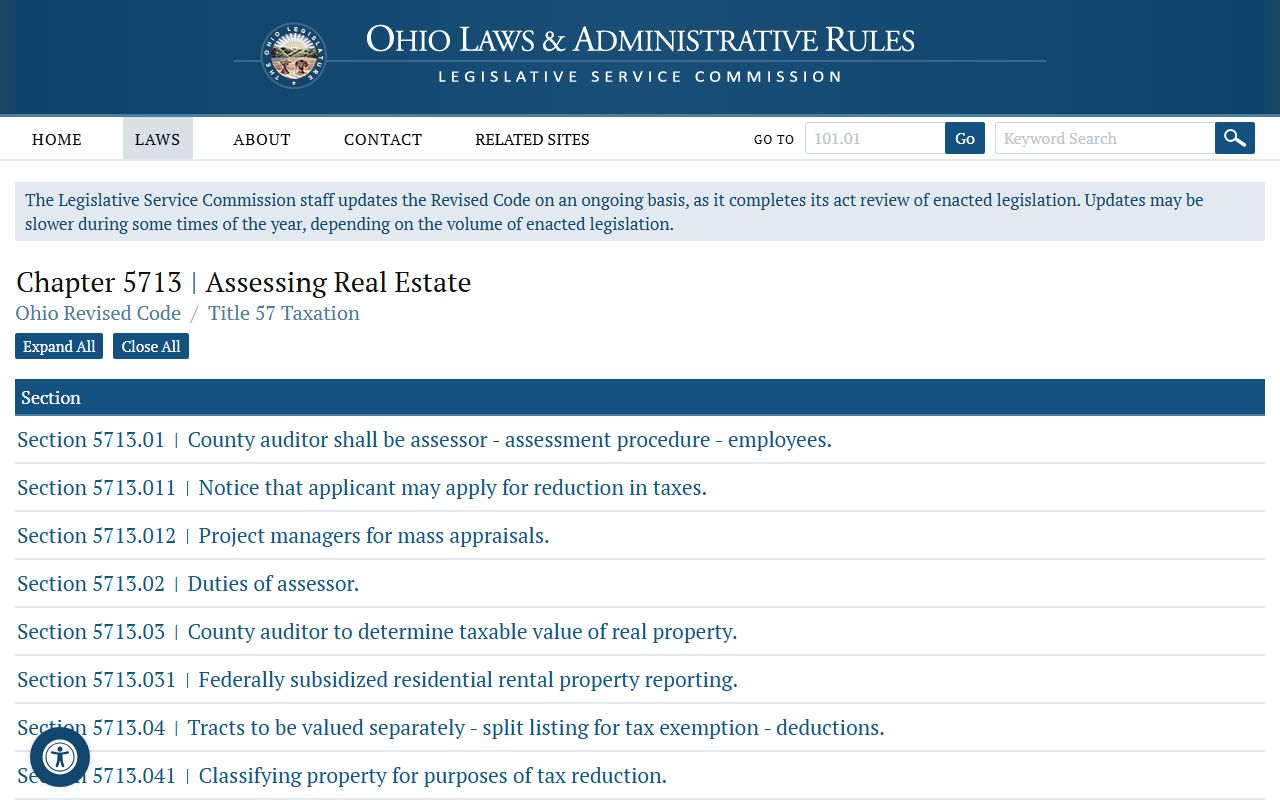
This page details the legal requirements for how the Brown County Auditor values property and keeps records current.
Note: Brown County's GIS mapping tool can be used to search by subdivision name in addition to the standard search options.
Brown County Tax Rates
Your tax rate in Brown County depends on which tax district covers your parcel. School districts, townships, villages, and special districts all have their own levies. The total rate is the sum of all applicable levies, stated in mills. One mill equals one dollar per thousand dollars of assessed value.
House Bill 920 controls how existing levies respond to reappraisals. When property values rise, the auditor adjusts existing levy rates down so the same amount of revenue is collected. New levies from recent elections are not adjusted. ORC Chapter 5705 sets the rules for levy authority. The Brown County Auditor certifies tax rates each year before the treasurer mails bills.
Exemptions in Brown County
Brown County residents can take advantage of several property tax exemptions. The homestead exemption removes up to $25,000 of market value for seniors 65 and over or permanently disabled homeowners. Veterans with a 100% disability rating can exempt up to $50,000. These exemptions reduce how much of your property value gets taxed.
Farmers in Brown County should consider the CAUV program. It values agricultural land at its production capacity rather than what it could sell for. This is a major benefit in a rural county with lots of farmland. The owner-occupied credit cuts 2.5% off the bill for people who live in their homes. The non-business credit provides a 10% rollback for residential property. Apply for these programs through the Brown County Auditor's office in Georgetown under the guidelines in ORC Chapter 319.
- Homestead exemption for seniors and disabled residents
- Enhanced homestead for 100% disabled veterans
- CAUV for qualifying farm and agricultural land
- Owner-occupied credit at 2.5%
- Non-business rollback credit at 10%
Paying Brown County Taxes
The Brown County Treasurer collects all property taxes. Bills go out in December. First half is due in February. Second half is due in July. Payment options include in-person visits to the treasurer's office in Georgetown, mail, and possibly online.
Late payments bring a 10% penalty plus interest. If taxes remain unpaid, the county can place a lien on the property. Eventually, the county may pursue foreclosure. Contact the treasurer early if you need help setting up a payment arrangement.
Property Tax Appeals
If your Brown County property value seems too high, file a complaint with the Board of Revision. The window is January 1 to March 31. DTE Form 2 is required. Bring comparable sales data or a recent appraisal.
The board meets in the spring at the county seat. After hearing your case, they issue a decision. You can appeal to the Ohio Board of Tax Appeals if needed. The process is laid out in ORC Chapter 5715. Most cases are handled at the county level.
Nearby Counties
Brown County is in southern Ohio. These neighboring counties have their own property tax records and rates.