
Search Allen County Tax Records
Allen County property tax records are managed by the county auditor in Lima, Ohio. This regional hub in western Ohio combines manufacturing and agricultural land, creating a varied tax base across the county. You can search for assessed values, parcel details, and tax payment history through the Allen County Auditor's office. The auditor also maintains an interactive GIS system for mapping parcels. Whether you own a home in Lima or farmland in the surrounding townships, all property tax records start with the Allen County Auditor.
Allen County Overview
Allen County Property Assessments
The Allen County Auditor handles all property assessments in the county. Under ORC Chapter 319, the auditor is the chief assessor. This means the office sets the market value for every parcel. Once a value is set, Ohio law requires it to be assessed at 35% of that market value. Your tax bill comes from that assessed value times the tax rate for your district.
Allen County uses an interactive GIS mapping system to track parcels. This tool lets you view property boundaries, zoning, and nearby features on a map. It is useful for checking lot size and location. The GIS data ties into the auditor's property records, so you can often click a parcel on the map and pull up tax and ownership information at the same time. The auditor's office in Lima can help if you have trouble using the online tools.
Reappraisals in Allen County follow the state-mandated six-year cycle with triennial updates. During a full reappraisal under ORC Chapter 5713, appraisers review sales data and may inspect properties. Triennial updates rely more on market trends and recent sales to adjust values without a full inspection. Both can change your tax bill, so it pays to check your value after each update.
Allen County Tax Records Search
You can search Allen County property tax records by owner name, address, or parcel number. The auditor's office maintains a database of all parcels in the county. Each record includes the owner's name, mailing address, parcel ID, legal description, and lot size. You will also find the land value, building value, and total assessed value.
Tax information is part of each property record. You can see the current tax amount due, past payments, and any delinquent balances. Special assessments for roads, sewers, or other local services show up here too. The Ohio Department of Taxation sets the broader rules for property tax, while the Allen County Auditor applies those rules at the local level.
The Allen County Auditor's website provides access to property tax records and GIS data. Below is a screenshot of the Ohio Department of Taxation portal, which outlines statewide property tax policies that apply to Allen County.
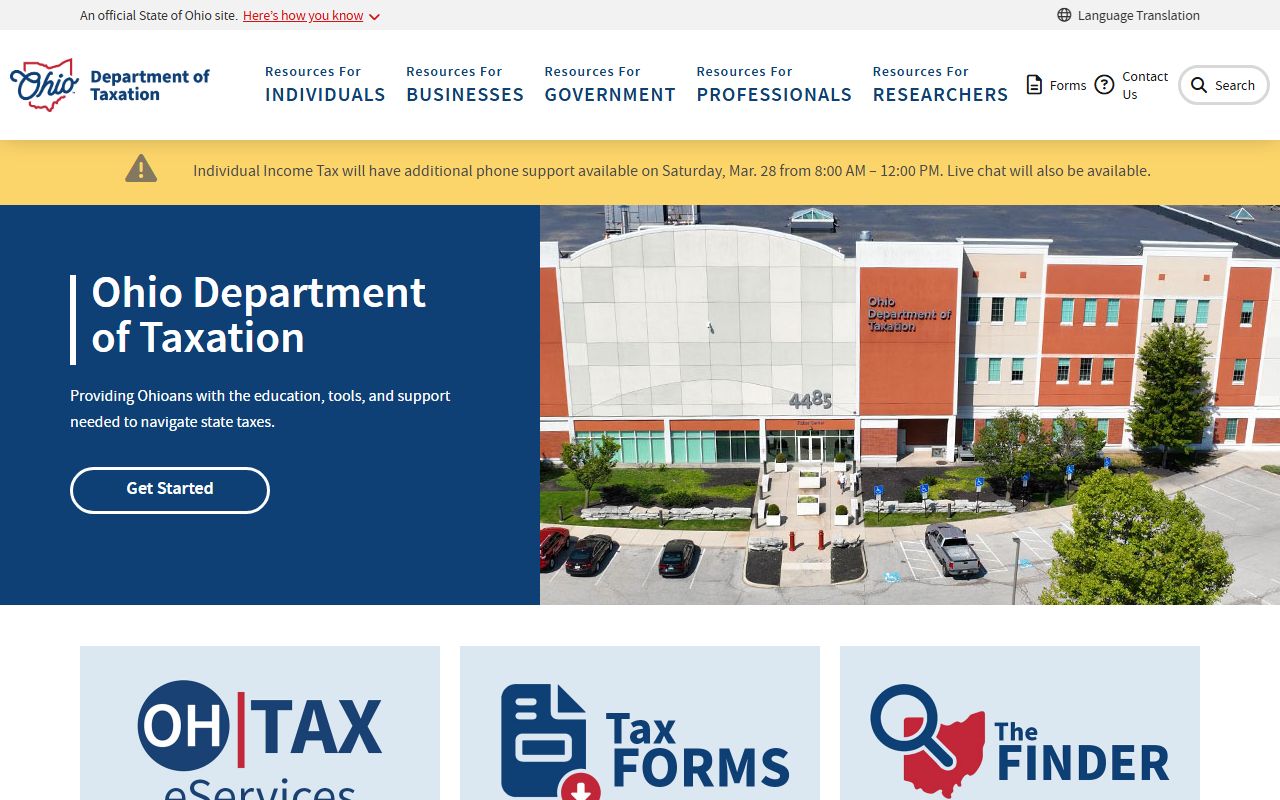
Allen County residents can use this state resource alongside local tools to understand their tax obligations and find forms for exemptions or appeals.
Tax Rates and Levies
Allen County has multiple tax districts, each with its own rate. Your rate depends on where your property sits. Levies fund schools, fire departments, libraries, parks, and other services. Rates are measured in mills. One mill is one dollar per thousand dollars of assessed value. Most districts in Allen County fall in a range typical for western Ohio.
House Bill 920 is important here. It creates reduction factors that keep your tax bill from jumping up every time property values rise. When the auditor completes a reappraisal and values go up across the board, HB 920 rolls back the effective rate on existing levies. New levies are not affected by this rollback. ORC Chapter 5705 governs the rules for how levies are put on the ballot and how rates are calculated. The Allen County Auditor certifies all tax rates before bills go out.
Note: Allen County tax rates can differ by more than 20 mills between districts, so always check your specific tax district.
Allen County Exemptions and Credits
Allen County residents can apply for several property tax relief programs. The homestead exemption helps seniors age 65 and over and permanently disabled homeowners. It exempts up to $25,000 of market value from your tax bill. Disabled veterans with a 100% service-connected rating can exempt up to $50,000. Applications go through the Allen County Auditor.
The owner-occupied credit gives a 2.5% reduction to homeowners who live in their property. The non-business credit (10% rollback) applies to residential property that is not primarily used for business. Farmers in Allen County may also benefit from the CAUV program. CAUV stands for Current Agricultural Use Value. It taxes qualifying farmland based on what the land produces rather than what it would sell for on the open market. That can mean a big cut in taxes for working farms.
- Homestead exemption up to $25,000 for seniors and disabled residents
- Enhanced homestead up to $50,000 for disabled veterans
- Owner-occupied credit of 2.5% on primary residence tax bills
- Non-business credit (10% rollback) for residential properties
- CAUV program for qualifying farmland and agricultural parcels
Paying Property Taxes in Allen County
The Allen County Treasurer is the office that collects property taxes. Tax bills are sent out each December. The first half payment is due in late January or February. The second half is due in July. You can pay at the treasurer's office in Lima, by mail, or through any online payment options the county offers.
Missing a deadline brings penalties. Ohio law sets interest on late payments, and continued non-payment can lead to a tax lien on the property. The treasurer publishes a list of delinquent properties each year. If you are struggling to pay, contact the treasurer's office early. Some counties offer payment plans or can point you to local assistance programs.
Filing a Property Tax Appeal
Property owners in Allen County who disagree with their assessed value can file a complaint with the Board of Revision. The board meets in Lima. Filing runs from January 1 through March 31. You need DTE Form 2 and supporting evidence. Comparable sales, a recent appraisal, or proof that the property has issues affecting its value all work as evidence.
The board holds hearings typically from April through June. After the hearing, the board issues a decision. If you still disagree, you can appeal to the Ohio Board of Tax Appeals under ORC Chapter 5715. That process is more formal and may take longer. Most cases settle at the county level, so bring strong evidence to your first hearing.
Cities in Allen County
The city of Lima is the largest city and county seat. Property owners in Lima use the Allen County Auditor for all property tax records. Lima has its own city income tax, but that is separate from the property tax handled by the county.
Nearby Counties
Allen County sits in western Ohio. These neighboring counties may be useful if you own property near the border or want to compare tax policies.